
Search LaFayette Property Records in Five Layers
Start with the current address. Early town lots predate modern street numbering. So keep the legal description beside the address at every step. An index or exported file may also normalize the city name differently. A parcel number and deed reference join systems more safely than the spelling alone.
- Try the physical address, owner, PIN, parcel, and Subdivsn fields in Chambers CAMA, including LaFayette spelling variants.
- Use Chambers Public GIS to place the tax parcel and preserve its legal description.
- Search Chambers Probate by grantor, grantee, description, deed reference, and Plat mode.
- Check the Revenue tax account and assessment as a county record, not a City Clerk value.
- Request annexation, rezoning, variance, permit, ordinance, or minutes material from the City Clerk by address and parcel.
The Chambers County property search walkthrough explains each portal field. For LaFayette, add historic lot terms, courthouse-square clues, approximate dates, and the exact municipal record category you want.
County Custodians and the LaFayette City Clerk
The courthouse at 2 South LaFayette Street anchors the county route. Probate records the land instruments. Revenue handles assessment and tax records. The Circuit Clerk holds referenced litigation, while the municipal clerk at 50 Alabama Avenue West keeps a separate layer of city action.
Chambers County Records
Probate, Revenue, and Public GIS supply recorded instruments, parcel cards, taxes, and map references.
LaFayette City Records
50 Alabama Avenue West
LaFayette, AL 36862
(334) 864-7181
The 1833 Lot Auction Frames LaFayette Land Records
Chambers County was created first. Officials then picked a near-center site for the courthouse. Lots auctioned in October 1833 helped finance a permanent courthouse and jail. The settlement began as Chambersville, became LaFayette, and incorporated on January 7, 1835. That timeline gives older searches useful terms. It also gives date windows. An early town lot may appear by plan, lot, adjoining owner, or public-square reference rather than a modern street number. History points the way. Only a deed, plat, and matching legal description connect an old lot to today's parcel.
Build a Precise LaFayette City Clerk Request
The city publishes no public permit or zoning-case database. A focused clerk request is the practical route. Give staff enough county data, such as a parcel number, to single out the property. Ask for an estimate before any staff-heavy search, and name the record category you need rather than every file tied to an address.
| Request field | What to provide |
|---|---|
| Property keys | Street address, parcel/PIN, CAMA owner, and legal description. |
| City action | Rezoning, variance, annexation, subdivision, permit, ordinance, or resolution. |
| Meeting trail | Approximate date plus agenda, minutes, packet, ordinance, or resolution number. |
| Name variants | Applicant, current or former owner, and former street or place name. |
| Delivery | Requested format, narrow date range, and a cost estimate. |
The official LaFayette Clerk page identifies the city records and contact channel.
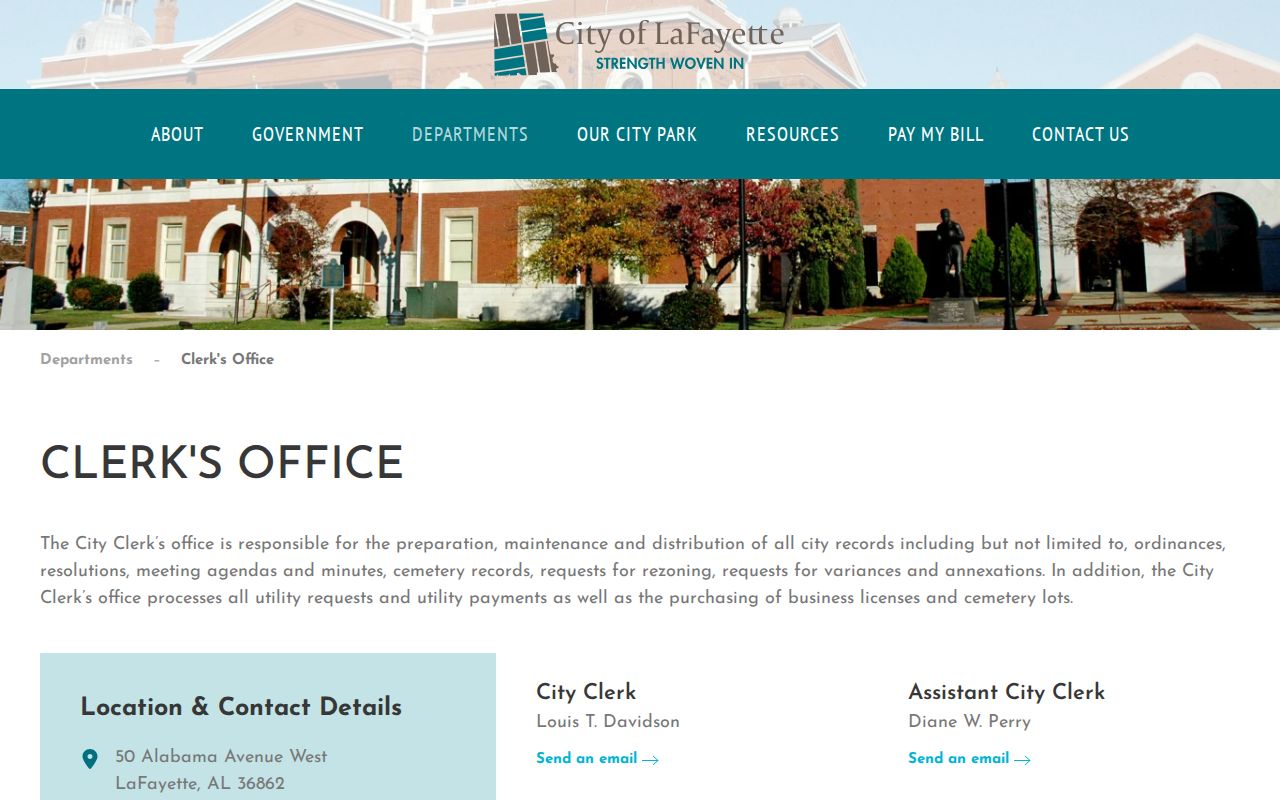
A request-based workflow fits land-use actions in LaFayette. It cannot replace the Chambers Probate deed and plat index.
Three LaFayette Spellings Can Change Search Results
The city and county usually write “LaFayette.” Some URLs and address strings use “Lafayette,” and Census TIGERweb uses “La Fayette.” Search all three spellings when a first attempt returns nothing, especially in historical OCR, exported data, and free-text descriptions. A case-insensitive portal may hide the difference. A newspaper archive or literal text match will not. Note the spelling each source actually displays, and never silently normalize a quoted address or old notice in a research log.
LaFayette Subdivision and Town-Lot Evidence
Chambers County publishes no single list of modern LaFayette subdivisions with book, page, and era data. Resist turning street names into invented neighborhoods. Use the courthouse-square town plan as historic context instead. Then rely on the county's two official subdivision-discovery paths for exact recorded names.
| Neighborhood / Subdivision | Era | In the Records |
|---|---|---|
| Original courthouse-site lots | October 1833 town formation | Search town-plan, Chambersville, public-square, lot, and deed references. |
| Courthouse Square Historic District | Late 19th and early 20th century context | AHC context for buildings and commerce, not a recorded subdivision or title source. |
| Recorded LaFayette plats | Discover by recorded date | Use CAMA Subdivsn plus Probate Plat mode; save subdivision, lot/block, page, slide, and date. |
Final plats must reach Chambers Probate before any sale, transfer, or building under the county process. Compare the recorded plat with the CAMA description. The Chambers parcel map guide can help. Municipal review records and county recording remain separate evidence.
The Courthouse Square Gives LaFayette Records Context
The Alabama Historical Commission's district material paints the square as a civic, business, and social center ringed by a turn-of-the-century Victorian courthouse and brick storefronts. That context can help interpret an old business-lot transfer. It also aids a photograph, ordinance, or newspaper notice. Try terms like “Courthouse Square,” “LaFayette square,” “Chambersville,” “East Alabamian,” “1st Street,” Alabama Avenue, and public-square phrasing. Then match any find to a modern parcel through its legal description. A landmark or district name is not a custodian. It cannot establish ownership either.
The county-seat setting explains why sources near the square look related yet answer to different custodians. Probate keeps conveyances and plats. Revenue maintains the tax card. The Circuit Clerk holds trial-court files. The municipal clerk keeps ordinances, minutes, and local land-use actions.
Note the issuing office on every copy you take home. A shared LaFayette address does not mean one desk can certify another office's record.
LaFayette 36862 Does Not Draw the City Limit
LaFayette, AL 36862 is the common mail pairing. USPS exact-address verification governs delivery. CAMA, GIS, and city annexation records answer other jurisdiction questions. No official ZIP-boundary map or realignment dates appear. Keep postal city, municipal city, county, tax district, and legal description as separate log fields. That habit pays off when a courthouse address looks familiar but an older parcel predates modern street numbering.
LaFayette Library and News Files Extend the Parcel Story
The Chambers County Library branch in LaFayette sits at 198 1st Street SE. It gives researchers a local base for directories, photographs, and newspaper digging. Its digital archive carries The Progress from 1917 plus other titles. Wider county material often sits at Cobb Memorial Archives in Valley instead. So plan on both stops. Call the archives ahead about maps, historic photos, directories, and unindexed newspaper pages. Ask whether an item carries a parcel, lot, street, or owner reference.
A newspaper story can explain a sale, an estate, or a change in building use. It can also cover a public project. It cannot stand alone. The recorded deed and the current tax card should confirm the property. They should also confirm which owner of record the item concerns. Ask staff about courthouse-square photographs and exact subdivision or plat references. Ask while you are there.
For an older commercial lot, build a five-column chronology: the deed or legal description, the AHC district account, the city ordinance or minutes, the CAMA building or improvement field, and a dated news notice. Conflicts between columns mark where more proof is needed. A building name can outlast several owners. A single tax-card year can untangle a messy construction history. Archive material supplies context only. A certified copy must still come from the government custodian of that record.
An Older LaFayette Lot Needs a Deliberate Access Order
An old courthouse-square or early town parcel rewards a deliberate order. Start with City Clerk minutes, ordinances, rezoning, variance, and annexation material tied to the site. Then search CAMA under the current address. Try every variant and preserve the PIN and legal description. Move to Probate next, searching grantor, grantee, description, plat, and book or page. Finish with the AHC district file. The library newspapers help interpret the building and lot chronology.
Reverse that order and an old public-square name can seem more exact than it is. The county card establishes the current assessment reference. Probate supplies the recorded instrument. City and archive material explains municipal action and history. When an estate, judgment, or boundary dispute enters the trail, add the Chambers County Circuit Clerk or the statewide court route. Never treat a docket as a replacement for a later deed.
Keep each query narrow enough for staff to answer. Name the parcel, the spellings tried, and the record category, the date range, and the format you want. If a municipal action surfaces, ask for the meeting packet reference. Also request the ordinance or resolution number. For a subdivision, request both the municipal review record and the final Probate plat. Approval and recording are separate steps.
County Assessment Governs LaFayette Parcel Values
The City Clerk does not set the county tax-card value. Chambers Revenue applies countywide and Alabama assessment rules inside LaFayette. A city file may document an annexation, zoning action, or permitted improvement. Keep those facts separate. The 2020 population count of 2,684 gives a sense of scale for the county seat. It is not a property-value series. The city publishes no assessed-value trend. Rely on a dated CAMA card and the live tax account for a parcel. Do not infer value from population or historic-district status.
When a LaFayette Parcel Leads to Court Records
A deed or a city minute may point to a dispute. That dispute could be an estate, a judgment, or a boundary action. Those case records live with the Chambers County Circuit Clerk and the Alabama court-access route. They do not sit with the City Clerk or the CAMA card. Bring the party names and the approximate date. Bring a case number if you have one, and the parcel description. Court material can explain what a dispute decided. The later recorded instrument still shows what actually entered the land-record chain.
What LaFayette Property Records Do Not Establish
LaFayette property records can show a tax-card owner field, a parcel description, a recorded deed or plat, a municipal action, and historic context. Each answers a different question on a different date. A city minute is not a deed, a map line is not a survey, and an assessment is not a market appraisal.
Lawful use. Use public records for property history, purchase diligence, boundary questions, estates, taxes, and civic transparency. This guide is not a title search, and owner information must never be used to harass or harm anyone.